Probate

Probate Collections Start with Finding the Estate

For banks, credit unions, and consumer lenders, probate collections often begin too late.

When a borrower passes, the account does eventually get flagged. However, by the time someone checks whether an estate exists, where it was opened, who the estate executor(s) are, whether a claim can be filed, and what the applicable court requirements are, it’s usually after filing deadlines have passed and the account gets written off.

This sequence creates an avoidable problem: probate collections depend on timely estate identification, but many lenders still treat estate research as a “when we get to it” task. A more effective approach starts by making probate identification an integral part of the account lifecycle.

Probate Collections Require a Different Process

Traditional collections practices work because most accounts follow a relatively predictable path. Specialty accounts, including estates, bankruptcies, and conservatorships do not. These accounts can become subject to processes that vary not only by individual circumstance, but also by legal jurisdiction. The CFPB notes that a deceased person's debts are generally paid from the estate, while responsibility for managing those debts may fall to an executor, administrator, personal representative, or another authorized person under applicable law. 

That means a lender cannot simply transfer a deceased account to a conventional collections queue and expect the same process to work. The organization needs to answer different questions, such as:

  • Where was the estate opened?

  • Who is authorized to act for the estate?

  • Can we file a claim before the deadline?

  • What court requirements apply to this account?

  • How will we monitor the account during resolution?


Finding Probate Estates is Just The First Problem

For many lenders, especially credit unions managing thousands of member accounts, the practical challenge isn't knowing that probate exists, but rather finding the estate among a large portfolio of accounts.

Manual research can require staff to search court records, identify potential matches, verify estate information, and determine whether an account belongs to the estate. The work becomes more difficult when lenders operate across multiple jurisdictions.

That is why probate estate identification deserves its own place in the recovery strategy.

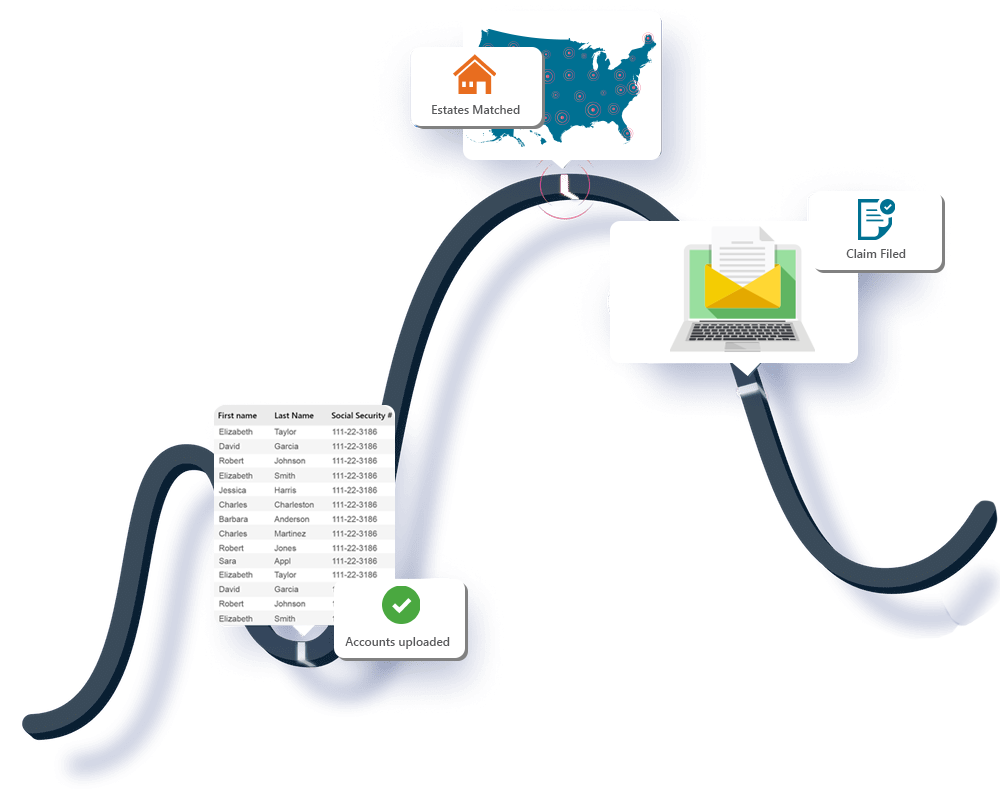
Our  Probate Finder OnDemand® service, for example, is designed specifically to automate probated estate location, matching, and claim presentation. The platform provides nationwide probate visibility and uses our proprietary Probate Finder technology to reduce reliance on manual, court-by-court research.

Why Credit Unions in Particular Should Pay Close Attention

Credit unions have another reason to examine this process closely: member relationships can make specialty-account handling especially sensitive. A credit union may want to preserve the member relationship with surviving family members while still fulfilling its responsibilities as a creditor. That requires a process that not only distinguishes the deceased borrower from the person authorized to manage the estate but does so with compassion and empathy.

Federal guidance reinforces the importance of that borrower vs. estate representative distinction. The CFPB explains that debt collectors may communicate about a deceased consumer's debt with people authorized to act for the estate, while they generally cannot treat family members as personally responsible for the deceased person's debt. 

For credit unions, that makes accurate estate identification more than a recovery exercise. It becomes part of a controlled process for determining who the organization should communicate with and how the account should move forward.

Finding the Estate Is Only the Beginning.

Once an estate is located, lenders still need to determine whether a claim is appropriate, prepare the necessary information, submit it through the applicable process, and monitor the account through resolution. Our probate technology works constantly to perform deceased-account identification, which results in our signature service being able to ensure quick estate location, thorough claim validation, timely filing, and ongoing monitoring. Learn more about these processes on our product page.

Build Probate Collections Into the Account Lifecycle

Between our probate recovery solutions, and Probate Finder OnDemand® for organizations that want to maintain aspects of recovery internally, we strive to be flexible for any size organization. A large bank may want an end-to-end outsourced solution, but credit unions and smaller lenders may want to retain control of internal collections operations while adding specialized probate research capabilities.

For organizations still treating probate research as an exception handled after someone notices a deceased account, we urge you to contact us and start a discussion around how we can potentially help your bottom line and at a substantial ROI.


 FAQ

Interview with a Probate Attorney

By Matt Rehnelt, Business Development Manager

In the probate and estate recoveries industries there are two distinct perspectives: that of the estate and that of the creditor. DCM Services has been well-versed in handling matters from the creditor’s perspective for more than 20 years, working with 25 of the top 100 auto lenders in the U.S. Throughout my career, I have found it extremely beneficial to thoroughly understand each point of view to achieve the best possible outcome.

Recently, I spoke with a local probate attorney to learn about the most common questions they hear from their clients on a regular basis, as well as how they would advise the estate to proceed. The answers I received were enlightening.

Q: If a family member recently passed away and has a car loan in their name only, can you continue to make the car payment until the vehicle is paid off?

A: The lender is probably within their rights to force a change. However, there are other issues – for example, you may need to register the vehicle and you may only be able to do that if you pay off the loan.

Insurance may also be a problem. If the vehicle is insured in the decedent's name, then the insurance company will balk at paying if there is a future claim. If and when the loan is repaid, the lender will issue a release to the decedent. How this release would apply to the new owner is also questionable.


If you can get around these items, then the main concern may be getting the vehicle retitled. If there is no probate estate and if the person in question is an heir, there is a simplified process. However, if probate is necessary, the auto loan will then need to be considered an asset of the estate before being transferred.

Q: So, what happens to that loan once it is considered an asset of the probated estate?

A: In most cases, a creditor is within their rights to file a claim against the probate estate. This will allow the remaining balance owed to be recognized against any of the assets in the probate estate. Before the probate estate can be formally closed, all creditors that had filed claims would need to be addressed in the correct order.

Q: That brings up a good point. Knowing whether the estate is going to have enough funds to resolve the debt is a huge time saver, because that ultimately lets a creditor know if they are getting a settlement in full, pro-rata, or nothing at all. What is your process of notifying creditors when there are not enough funds to resolve claims?

A: Well, most attorneys I know have a pretty similar process. The Personal Representative must look at the claims that have been filed and determine which debts get paid first. Under many state laws, there is a specific order in which the debts must be paid:

Priority of claims

  1. Costs and expenses of administering the estate, including attorney’s fees.

  2. Reasonable funeral expenses will be paid.

  3. Any debt that has preference under Federal law, including for example, Federal taxes.

  4. Expenses for medical costs or hospital stays for the decedent’s final illness and/or secure debts (i.e., boat loans, auto loans, etc.).

  5. Expenses for medical costs or hospital expenses incurred during the year before death.

  6. Any debts under federal law, such as state taxes, and last, any other unsecured debt. The personal representative pays the debts in this order, not in the order in which the claims are received.

Once the assets of the estate run out, then the debts that are further down the priority list will simply not be paid or will need to be pro-rated based on remaining funds.

In the event the estate is insolvent, or unable to pay creditors, we will typically work with the Personal Representative to prepare an itemized inventory of all of the debts and assets. Ultimately, this provides the creditor with some form of documentation showing the estate truly does not have the funds to resolve their claim. Typically, this documentation is not sent to creditors unless requested because of the extra charges brought upon an estate that is already lacking funds.

Q: Interesting. My last question is a bit of a tough one. Do attorneys ever “bend the truth” to make it look like the estate does not have funds to pay claims?

A: I do not want to speak on behalf of all legal counsel in the United States, but it’s not out of the realm of possibility. I think that ultimately, a Personal Representative retains an attorney to represent the estate for a couple reasons; the first is due to the nature of probate, it can be a time intensive process. Personal Representatives negotiating on their own means less time with their family and more than likely taking time off of work.

The second reason is that attorneys can typically save a good portion of funds for the estate by either negotiating debts down, accepting settlements, and/or taking advantage of other state statutes that legally allow heirs to receive certain funds prior to creditors, such as homestead laws or administration fees.

Ultimately, probate proceedings can take up to a year or two, the assets are typically "frozen" until the courts decide on the distribution of the property. Probate can easily cost between 3% and 7% or more of the total estate value. If the estate does have liquid assets available, it sometimes in the best interest of all parties to resolve the estate in a timely manner.

Q: I appreciate you talking with me today and agreeing to be part of my new series “Interviews with a Probate Attorney”. Is there anything else you would like to add?

A: My biggest suggestion for individuals who are looking to retain an attorney to assist in probate, setting up a trust, transfer on death [deeds or accounts], or any other matter, is to choose someone that they feel comfortable with and share the same values and ethics. Having a certain level of trust, creates peace of mind and makes the entire process that much easier.

The contents of this article are not intended as legal advice. This article is intended only for general informational purposes. If you have any questions, please consult with your legal counsel.

About the author

Matt-R.jpg

Spending a majority of his career working within the financial services and healthcare industries, Matt has worked with DCMS since 2010. Matt works hand-in-hand with organizations to create and enhance their estate recovery process. Matt graduated from Metropolitan State University with his Bachelors in Business

Administration.

Connect with Matt on LinkedIn →

Putting the “Pro” in Probate

How Probate Finder OnDemand® revolutionizes the probate process.

By Jason Hamey, Probate Finder Team Lead

The final version of the original U.S. Uniform Probate Code (UPC) was enacted in 1969, when a gallon of gas cost $0.35 and you could buy a new house for the price of your current car. While probate law has been revised over time, the vast diversity of the 3,415 state probate courts has left an entangled web of various court rules and restrictions, some of which date back to the original UPC.

probate-map-PFOD.png

Manually attempting to recover on probated estates often ends up costing more money than any revenue that may follow. Probate Finder OnDemand removes manual probate work for your team and allows you to maintain process ownership, all while controlling costs by locating open estates and filing claims on those which best fit your portfolio.

To overcome this vast challenge to maintain rules, we have dedicated teams of specialists who manage those changes for Probate Finder OnDemand behind the scenes.

“Behind the scenes” teams of Probate Finder OnDemand

Probate Finder OnDemand operations consist of five unique teams who work in tandem to facilitate the probate process end-to-end. Here’s a brief overview of each team:

  • Probate Finder Data Team: Captures probate estate records filed throughout the nation and adds this data to the nationwide Probate Finder® database. They also work with the probate courts to create reliable processes and ensure accurate data is sourced. Nearly 45,000 probate records are added monthly.

  • Probate Finder Claims Team: Manages claim filing requirements for all probate courts and ensures compliance with highly regimented claim filing procedures.

  • Quality Assurance Team: Our Quality Assurance team conducts regular quality control audits to ensure claim processing is compliant with the applicable processes and procedures.

  • Development Team: In-house development team who builds and maintains our state-of-the-art systems. This team performs ongoing review and application updates that focus on accuracy, quality, compliance, transparency, and user experience.

  • Probate Finder OnDemand Customer Care Team: Dedicated team to support partnership success by providing system training, addressing probate related questions, and collaborating to fine tune strategies.

Innovative technology and user experience

The controls and considerations provided by each team are built within our Probate Finder technology and are nothing short of astounding. As one of our clients somewhat jokingly put it, “This is better than the system in our offices. Is it for sale?” We locate an open probated estate for one of your accounts, you are notified of the match and it is up to you to decide if you want to file a claim. If you choose to proceed, the account data is validated by someone at your office to ensure accurate information.


After providing your claim approval, the Probate Finder technology will generate a claim for your account systemically. This means that our technology recognizes where the claim is going, which claim form is required, the rules and requirements of that jurisdiction (such as the color of paper and number of copies required), and creates the claim. Once the claim package is printed, signed, and notarized, we create a PDF image and upload it into the Probate Finder OnDemand application. This ensures that your team will always have access to a copy of the signed document.

Remove manual probate work for your team and maintain process ownership, all while controlling costs by filing claims on estates which best fit their portfolios.

Remove manual probate work for your team and maintain process ownership, all while controlling costs by filing claims on estates which best fit their portfolios.

Finally, the claim is mailed or electronically filed with the appropriate parties. Each step of this process has controls to ensure data and process accuracy. If a data element changes at any time during processing – whether you update information in the Probate Finder OnDemand application or our data record in Probate Finder receives updated information – the claim will be voided automatically, and the entire process begins anew.

The Probate Finder OnDemand Customer Care Team helps your team employ a robust post-claim process as well. You may have filed a claim and would like to amend the filing, we can do that for you as well. If a claim was returned by the court due to a process change, we will thoroughly investigate the change and a new claim will be presented. Or maybe your claim simply was not received, we will review the account and get a new claim filed. All of this is included in our solution and done through the Probate Finder OnDemand application by a click of a button.

Want to see Probate Finder OnDemand in action? Schedule a demo with a probate specialist.


Probate+Finder+OnDemand+Overview+_+DCM+Services.png

Learn more about the cutting-edge features of Probate Finder OnDemand that you won’t find in this article.

Download the overview


DCM Services Celebrates 20-Year Milestone

“Throughout its evolution, DCM Services has created a strong reputation for building superior proprietary technologies, consulting closely with its clients, and remaining committed to our cultural values that are reflected throughout the organization,” said Tim Bauer, chief executive officer. “We have been on an incredible journey as an organization over these last 20 years…”

DCM Services Announces New CEO

DCM Services (DCMS), the industry leader in estate and specialty account recovery solutions, is pleased to announce the appointment of industry veteran Tim Bauer as chief executive officer, effective October 23, 2017. Bauer joins DCMS from insideARM, where he has been serving as president…