Probate Finder OnDemand

Estate Collections: How the Great Wealth Transfer Is Rewriting the Rules

A generational shift in wealth is exposing a gap most portfolios haven't accounted for, and it has nothing to do with probate.

Over the next two decades, Cerulli Associates projects that approximately $124 trillion in wealth will transfer in the U.S., with roughly $105 trillion passing to heirs and $18 trillion to charitable organizations. This will be the largest intergenerational wealth transfer in history. Most of the commentary around it is written for financial advisors and estate planners: how to prepare portfolios, how to talk to heirs, how to avoid probate, etc. Almost none of it is written for the people who actually service the accounts sitting inside that wealth, such as credit cards, auto loans, mortgages, utility accounts, and healthcare balances that don't pause just because a family is quietly navigating a parent's declining capacity. Estate collections, as an industry, has spent decades building processes for what happens after someone dies. The bigger, messier problem is what happens in the years before.

The Estate Collections Industry Was Built for What Happens After Death

Traditional estate collections is a post-death discipline: identify the date of death, locate the estate, file a probate claim, engage the executor. It's a mature process built around a single clear trigger event. The problem is that trigger event is arriving later and later relative to when an account actually needs specialized handling. As Americans live longer with chronic illness and cognitive decline, the gap between "someone else is now managing this account" and "this person has died" has stretched into years, not weeks, for a growing share of aging accountholders. A parent with early-stage dementia might have a durable power of attorney active on a mortgage account for three or four years before death. A conservatorship might govern a credit union member's finances well before any estate is opened. By the time a probate court gets involved, the account may have already been through multiple authority changes that a typical collections or servicing workflow never flagged, verified, or documented.

Powers of Attorney, Guardianship, and Diminished Capacity

Three legal mechanisms account for most of this pre-death complexity, and each creates a different verification problem. A durable power of attorney lets someone act on an accountholder's behalf, but its scope varies by document and by state, and it can be revoked, superseded, or forged. This confirms that a POA is current and broad enough to authorize a given transaction is its own compliance exercise. Guardianship and conservatorship, by contrast, are court-ordered and typically broader in scope, but slower to establish and easy to mishandle if a servicer doesn't recognize the appointment or misapplies it to the wrong account. And diminished capacity without any formal legal instrument in place leaves institutions with no clean authority to rely on at all, just a family member calling in, sincere but unauthorized.

None of these are decedent accounts. None of them show up in a probate filing. But all three now sit squarely inside what estate collections has to account for, because all three change who's actually managing money on an account that's still, technically, open and active.

One Trend Hits Different Pressure Points Across Every Portfolio

This wealth transfer will end up touching every industry of servicer differently, so you will need to prepare differently. Here are a few examples:

  • Credit unions and banks — an aging member base means power-of-attorney and guardianship activity on deposit and loan accounts is becoming routine rather than rare, and misapplied authority is a direct member-trust risk.

  • Auto lenders — an adult child managing a parent's vehicle loan under power of attorney, or a conservator authorizing a vehicle sale, both require a different verification path than a standard delinquency workflow assumes.

  • Mortgage servicers — Regulation X successor-in-interest protections already require servicers to identify and correctly communicate with parties who have an interest in a property; power-of-attorney and guardianship scenarios extend that same obligation earlier, well before any death or transfer of title.

  • Healthcare providers — a patient under conservatorship, or with an activated healthcare power of attorney, changes who can authorize billing decisions and payment arrangements, often long before end-of-life care becomes a factor.

Building an Estate Collections Strategy That Starts Before Probate

The fix looks a lot like the discipline estate collections already applies after death, just moved earlier. That means continuous verification of legal authority, not only date of death: confirming a power of attorney is current, properly executed, and broad enough to cover the transaction at hand. It means documentation standards specific to guardianship and conservatorship, so an appointment is recognized and applied to the right account the first time, not discovered after a dispute. And it means training frontline staff to tell the difference between a validly authorized representative and a well-meaning but unauthorized family member. This distinction matters as much for compliance as it does for preventing elder financial exploitation.

Organizations that build this capability are closing a compliance gap that opens years earlier than this process typically engages, and building the kind of institutional trust that a wealth transfer this large is going to reward or punish, depending on who got it right.

The Wealth Transfer Will Test Every Servicer's Definition of "Estate"

The Great Wealth Transfer will keep making headlines as an inheritance story. For anyone actually responsible for servicing accounts, it's a different story entirely, where estate collections starts long before a death certificate exists, and where the institutions that build for that reality now will be the ones still trusted by the next generation of accountholders when the money actually changes hands.

Are You Prepared? DCM Services Can Help!

We’re constantly working to stay ahead of socioeconomic factors that would otherwise contribute to consumer lenders being forced to write off decedent accounts that weren’t claimed within the deadline. And this is just one of the growing needs organizations like yours has for DCM Services to provide proprietary solutions like Probate Finder OnDemand® or our Signature Service. If you would like to learn more about our approach to estate collections, or if you have a major revenue gap in your portfolio due to unclaimed estate recoveries, contact us today!


Frequently Asked Questions

What is estate collections?
Estate collections is the practice of identifying, verifying, and recovering or servicing accounts connected to an estate. It's traditionally understood as post-death probate recovery, but increasingly includes pre-death situations where a power of attorney, guardian, or conservator is managing an accountholder's finances on their behalf.

How does the Great Wealth Transfer affect estate collections?
As a historic volume of wealth moves from an aging population to heirs over the next two decades, more accounts are passing through extended periods of power-of-attorney or guardianship management before death, which means this side of the business has to account for years of pre-death authority changes, not just a single post-death trigger event.

What's the difference between pre-death and post-death estate collections?
Post-death estate collections is triggered by a confirmed date of death and typically involves probate court filings and executor engagement. Pre-death handling, by contrast, deals with active accounts being managed by a power of attorney, guardian, or conservator, where the original accountholder is still alive but no longer the one directing financial decisions.

Which industries are most exposed to pre-death estate account complexity?
Credit unions and banks with older member bases, auto and mortgage lenders, and healthcare providers all see rising volumes of power-of-attorney and guardianship activity as their populations age, each requiring a different authority-verification approach than standard delinquency or probate workflows.

What should organizations do to prepare for this shift in estate collections?
Build continuous processes for verifying legal authority, not just date of death, train staff to distinguish valid authorized representatives from unauthorized family contacts, and treat power-of-attorney and guardianship activity as its own compliance category rather than an informal precursor to probate.

What a 7,500% ROI Teaches Finance Leaders About Fixing Reactive Estate Recovery Processes

Every organization that involves consumer lending and finance has at least one process that everyone privately agrees is broken, but no one has had the bandwidth to fix. For a lot of companies managing claims, receivables, or estate recovery, that process looks something like this: manual searches, delayed identification, missed windows, and a recovery strategy that only ever reacts after value has already been lost.

Our recent case study from Probate Finder OnDemand® puts a hard number on what that inefficiency is costing your organization and what happens when it's automated instead.

The Problem: Recovery That Only Happens After the Fact

The case study client in question, a major not-for-profit financial services company in the Midwest, was running its estate recovery process manually, the way most organizations still do. When an account holder passed away, the team had to identify probated estates, track claim eligibility, and file within tight statutory windows. There was no systematic way to know which estates existed or where they stood in the process.

The result was predictable. Estates went unidentified. Claims filing deadlines were missed. Recoverable dollars simply disappeared into an inefficient pipeline, not because they weren't real, but because no one caught them in time.

This is a familiar shape of problem well beyond estate recovery. Any B2B function that depends on time-sensitive identification bleeds value the same way. The cost may not be visible on a P&L line because it's the money that was never even counted, as it never turned into a claim.

The Fix: Automating Identification, Not Just Filing

Instead of trying to work faster within the same reactive model, the company implemented Probate Finder OnDemand® to automate the identification process itself. Rather than relying on staff to manually search and cross-reference probate records, the system flagged probated estates automatically and routed them into the claims workflow. This turned a slow, manual search into a continuous, systematic process that didn’t require any new staff or hardware.

The operational shift mattered as much as the technology. Our solution integrated directly into existing systems, gave the team direct access to probate data, and freed up staff who had been spending hours on manual searches to focus on higher-value work. Efficiency gains both sped up the process and created capacity that could be redirected elsewhere in the organization.

The Results: What Automated Recovery Actually Delivers

In a single year, the shift from reactive to automated identification produced:

  • $1.86M in probate claims filed

  • 7,500% ROI (and growing)

  • One partial month of settlements paid for a full year of Probate Finder OnDemand® access.

  • A 26% probated estate location rate, meaning roughly 1 in 4 estates identified were ones the manual process would likely have missed entirely

The estates were always there. The company was failing to earn recoverable dollars because they were failing to see them in time. Using Probate Finder OnDemand® didn't invent value; it recovered value that already existed but was previously invisible to a manual process.

Why DCM Services is Your Organization’s Partner Solution

Results like these don't come from bolting a useful tool onto a broken process. Rather, they come from a partner that understands how recovery actually works end-to-end and is willing to help you create an optimized process. DCM Services has spent years helping organizations from many industries modernize exactly this kind of reactive, manual workflow, and combine deep domain expertise with technology that integrates cleanly into the systems their teams already use. We are a team that understands the compliance windows, the data complexity, and the operational realities that make estate recovery hard to get right.

If your organization is running claims, receivables, or recovery processes on a reactive, manual foundation, there's a strong chance you're leaving recoverable value on the table right now.

Contact us today to see what an automated approach could recover for your organization.


Download the Case Study to Share with Your Team

Credit Union Case Study.pdf
Click the PDF icon to download.

DCM Services Launches Major Upgrade to Probate Finder OnDemand® with New Functionality

MINNEAPOLIS – DCM Services, LLC (“DCMS”) and its sister company, Forte, LLC, the industry leaders in data and contact management solutions for the estate and specialty receivables recovery market, celebrate the launch of a major upgrade to the Probate Finder OnDemand application.

Probate Finder OnDemand provides client access to Forte’s patented Probate Finder® technology and automates robust and time-consuming probate location, matching, and claim presentation processes. All of this happens within a secure interface, simplifying the user experience and automating an otherwise manual process. Launched in 2010, its Software-as-a-Service (SaaS) model has grown to serve over 200 organizations spanning several end-markets including financial services, auto, retail, credit unions, government, and healthcare.

DCMS CEO Tim Bauer, reflected on the utility of the product, “Probate Finder OnDemand is the only SaaS tool of its kind providing our clients with a simple and efficient way to identify probated estates. It then goes further to allow our clients a seamless opportunity to file a claim on the probated estate. This new redesign provides more tools for our clients and makes it easier to use.”

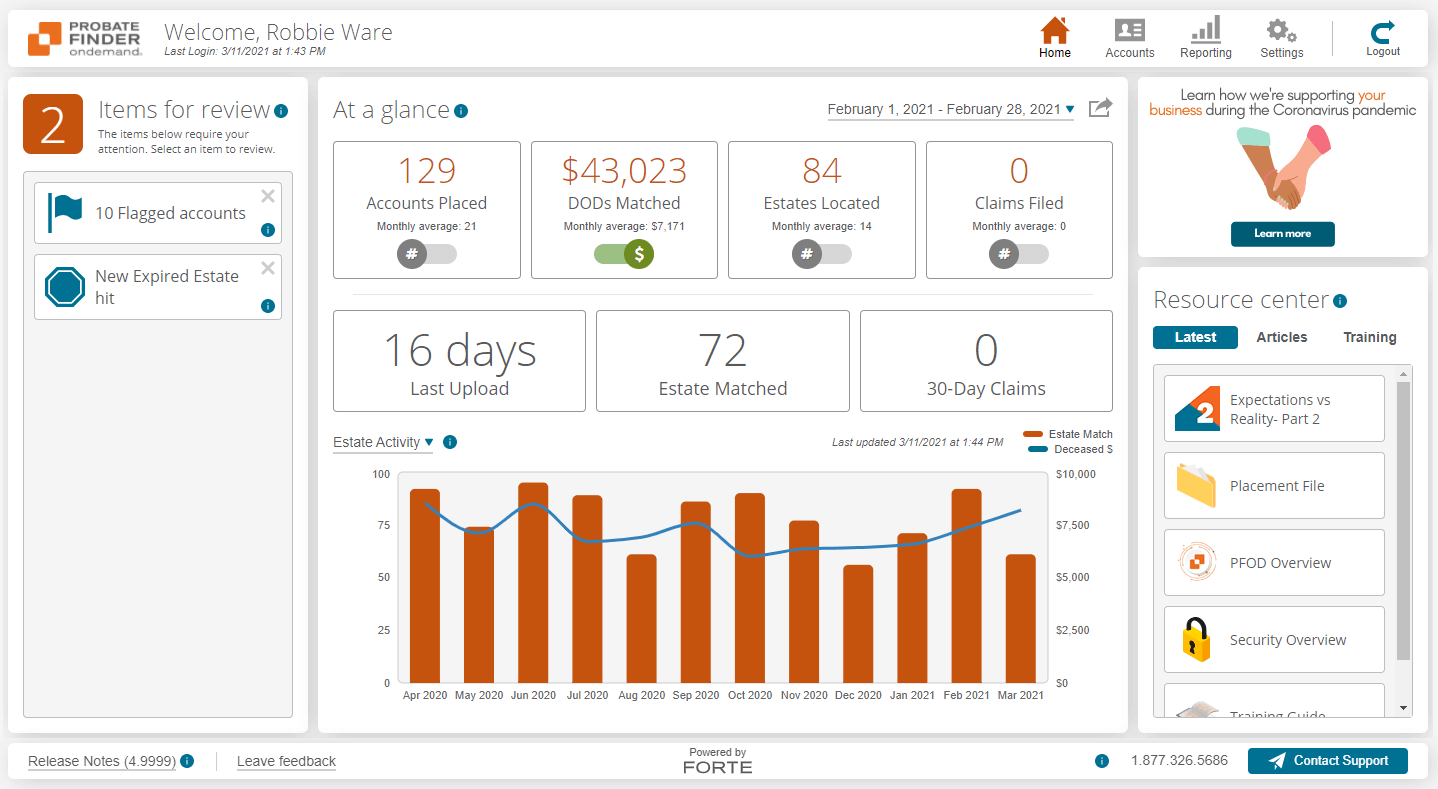
Since its inception, the application has been continuously developed based on direct client feedback and user needs. The upgraded user experience offers impactful new features such as a notification system, insightful dashboard reporting tools, and an educational resource center. These features put relevant and actionable information in focus for Probate Finder OnDemand’s valued clients.

The newly enhanced Home dashboard puts your team in control with the perfect balance of insight and action.

The newly enhanced Home dashboard puts your team in control with the perfect balance of insight and action.

Chief Technology Officer and creator of Probate Finder OnDemand, Dereck Eastman was ecstatic, “This new version of our application highlights DCMS’ perpetual focus on improving the products and services we deliver to our customers. The new design brings a fresh look and feel to the application while maintaining the core workflow of the product which continues to make it the easiest way for creditors to locate probated estates and present claims across the country.”

Sr. Product Manager and project owner Sara Brown said, “We pride ourselves in the innovative vision of Probate Finder OnDemand, and this new upgrade is the next step in the product evolution. The revamped dashboard empowers our customers with critical information and educational resources to help drive their success.”

Learn more about how Probate Finder OnDemand revolutionizes the probate recoveries process here →

--

This press release was also featured on insideARM, AccountsRecovery.net, and Probatefinder.com.

About DCM Services
Minneapolis-based DCM Services is the industry leader in estate and specialty account resolution services, maximizing the value of client portfolios across financial services, healthcare, auto, retail, telecom, credit union, government and utilities industries through innovation and performance. Its recovery solutions offer a full range of services from proprietary web-based solutions to full outsourcing, maintaining an unmatched spectrum of innovative solutions that increase recoveries, protect brand value, and enhance survivor relationships – with respect and sensitivity. For more information on all DCM Services’ offerings, please visit www.dcmservices.com.

Join 1,400+ industry professionals in following DCM Services on LinkedIn →

Putting the “Pro” in Probate

How Probate Finder OnDemand® revolutionizes the probate process.

By Jason Hamey, Probate Finder Team Lead

The final version of the original U.S. Uniform Probate Code (UPC) was enacted in 1969, when a gallon of gas cost $0.35 and you could buy a new house for the price of your current car. While probate law has been revised over time, the vast diversity of the 3,415 state probate courts has left an entangled web of various court rules and restrictions, some of which date back to the original UPC.

probate-map-PFOD.png

Manually attempting to recover on probated estates often ends up costing more money than any revenue that may follow. Probate Finder OnDemand removes manual probate work for your team and allows you to maintain process ownership, all while controlling costs by locating open estates and filing claims on those which best fit your portfolio.

To overcome this vast challenge to maintain rules, we have dedicated teams of specialists who manage those changes for Probate Finder OnDemand behind the scenes.

“Behind the scenes” teams of Probate Finder OnDemand

Probate Finder OnDemand operations consist of five unique teams who work in tandem to facilitate the probate process end-to-end. Here’s a brief overview of each team:

  • Probate Finder Data Team: Captures probate estate records filed throughout the nation and adds this data to the nationwide Probate Finder® database. They also work with the probate courts to create reliable processes and ensure accurate data is sourced. Nearly 45,000 probate records are added monthly.

  • Probate Finder Claims Team: Manages claim filing requirements for all probate courts and ensures compliance with highly regimented claim filing procedures.

  • Quality Assurance Team: Our Quality Assurance team conducts regular quality control audits to ensure claim processing is compliant with the applicable processes and procedures.

  • Development Team: In-house development team who builds and maintains our state-of-the-art systems. This team performs ongoing review and application updates that focus on accuracy, quality, compliance, transparency, and user experience.

  • Probate Finder OnDemand Customer Care Team: Dedicated team to support partnership success by providing system training, addressing probate related questions, and collaborating to fine tune strategies.

Innovative technology and user experience

The controls and considerations provided by each team are built within our Probate Finder technology and are nothing short of astounding. As one of our clients somewhat jokingly put it, “This is better than the system in our offices. Is it for sale?” We locate an open probated estate for one of your accounts, you are notified of the match and it is up to you to decide if you want to file a claim. If you choose to proceed, the account data is validated by someone at your office to ensure accurate information.


After providing your claim approval, the Probate Finder technology will generate a claim for your account systemically. This means that our technology recognizes where the claim is going, which claim form is required, the rules and requirements of that jurisdiction (such as the color of paper and number of copies required), and creates the claim. Once the claim package is printed, signed, and notarized, we create a PDF image and upload it into the Probate Finder OnDemand application. This ensures that your team will always have access to a copy of the signed document.

Remove manual probate work for your team and maintain process ownership, all while controlling costs by filing claims on estates which best fit their portfolios.

Remove manual probate work for your team and maintain process ownership, all while controlling costs by filing claims on estates which best fit their portfolios.

Finally, the claim is mailed or electronically filed with the appropriate parties. Each step of this process has controls to ensure data and process accuracy. If a data element changes at any time during processing – whether you update information in the Probate Finder OnDemand application or our data record in Probate Finder receives updated information – the claim will be voided automatically, and the entire process begins anew.

The Probate Finder OnDemand Customer Care Team helps your team employ a robust post-claim process as well. You may have filed a claim and would like to amend the filing, we can do that for you as well. If a claim was returned by the court due to a process change, we will thoroughly investigate the change and a new claim will be presented. Or maybe your claim simply was not received, we will review the account and get a new claim filed. All of this is included in our solution and done through the Probate Finder OnDemand application by a click of a button.

Want to see Probate Finder OnDemand in action? Schedule a demo with a probate specialist.


Probate+Finder+OnDemand+Overview+_+DCM+Services.png

Learn more about the cutting-edge features of Probate Finder OnDemand that you won’t find in this article.

Download the overview