
Most Organizations Have a Decision Problem Rather Than a Data Problem
Over the past decade, data leaders built warehouses, licensed new feeds and launched dashboards across the enterprise. Yet the same accounts still stall in the same queues. More information arrived, but better decisions didn’t follow. The gap is whether your information is actionable data: verified, matched to the right record, owned by a specific person and tied to a defined next step. Without knowing what you’re looking at, even excellent data sits in a report until someone happens to notice it.
Why More Data Doesn’t Guarantee Better Decisions
Every new data source adds value. It also adds clutter, review time and reconciliation work. When teams can’t tell which inputs matter, they slow down or fall back on the old process. The cost for this can be substantial. Gartner research estimates that poor data quality costs organizations an average of $12.9 million per year. That figure counts bad data. It doesn’t count good data that never reached a decision.
That second cost has a name: decision latency, the time between a signal arriving and someone acting on it. Latency is where value quietly hemorrhages. Picture a lender that receives a monthly file of possibly deceased customers. The file lands in a shared folder. An analyst reviews it when time allows. By the time an account moves, the estate’s creditor claim window may have closed. The data was there. The decision process wasn’t.
A Data Signal Is Not a Verified Account Event
Most data feeds deliver signals. Operations teams need events. The two are easy to confuse, and that confusion drives most downstream failures.
A data signal suggests something might be true. A name and date of birth resemble a death record. Mail comes back undeliverable. A phone number gets disconnected.
A verified account event confirms something is true, ties it to a specific account and carries enough context to act. A confirmed date of death, matched to the right account holder, with a known estate status, is an event.
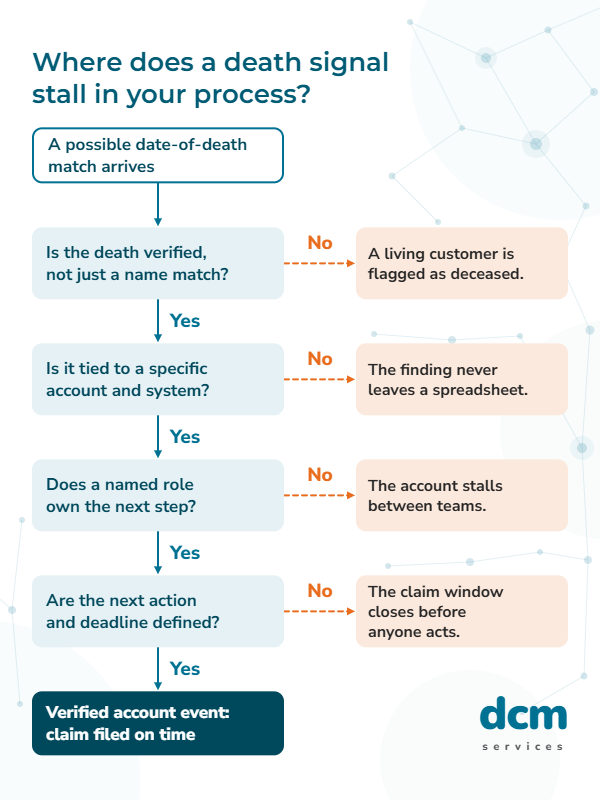
Acting on unverified signals creates risk. A living customer flagged as deceased is a service failure and a potential compliance issue. Ignoring signals creates loss. Verification is what separates actionable data from the clutter. One source rarely gets you there, unless you have the tools and expertise we do at DCM Services.
The Four Requirements for Actionable Data
Actionable data meets four conditions. Miss one, and the chain breaks.
Verified signal
The information is confirmed against authoritative sources, not just matched on probability.Useful matching
The event connects to the account, product and system where work actually happens, not just to a name in a file.Clear ownership
A named team or role owns each event type. “Operations” is not an owner.Defined next action
Each event triggers a documented step with a deadline: route the account, adjust contact, or file a claim.
Most organizations handle the first requirement well and assume the other three will follow. They usually don’t.
How to Connect Research Outputs to Company Operations
Research outputs often end life as files. Files aren’t workflows. Actionable data needs a destination, and these five moves give it one:
Define the event
Agree on what counts as confirmed and which fields every event must carry.Route into the system of record
Send events where work is assigned instead of an inbox or spreadsheet.Attach a service level
Give every event type a time-to-action target.Measure outcomes
Track accounts resolved rather than flagged records.
This is where transformation programs succeed or stall. The technology usually works. The handoff usually doesn’t.
Where Technology Meets Expertise
Deceased and probated accounts show the problem clearly. The data exists across thousands of courts and records. The hard part is turning it into the right action, on the right account, before the window closes.
Here at DCM Services, we pair proprietary probate research and patented date-of-death technology with specialists who translate findings into action. Our probate research covers more than 3,400 courts nationwide. Verified events then move into defined workflows: claims prepared and filed, accounts routed correctly and surviving families treated with respect. The goal isn’t necessarily to have more data. Rather, we care more about actionable data and fewer missed decisions.
Quick Answers
What is actionable data?
Actionable data is information that is verified, matched to a specific account or record, assigned to an owner and linked to a defined next step.
What is the difference between a data signal and a verified account event?
A data signal suggests something may be true. A verified account event confirms it, ties it to a specific account and provides enough context to trigger action.
Assess Your Data-to-Decision Readiness
Before you buy another data feed, test the ones you already have. The next time a date of death match lands on your desk, use "Data-to-Decision Readiness” to look from signal verification to defined next actions so you can see exactly where decisions stall. Whether you do this or not, feel free to contact us any time, and we’ll be delighted to go over your organization’s specific situation with you.