
Last August, we looked at how the Great Wealth Transfer is forcing estate collections work to happen earlier to include the years when a power of attorney, guardian, or conservator may be managing an accountholder's finances. On the other end of that timeline, recovering balances from deceased account holders depends on three things: an estate you can find, a representative with legal authority to act, and enough time to file a claim. New research suggests all three are harder to secure than most recovery strategies assume.
What Does New Research Say About Estate Readiness?
Most families are far less prepared for a death in the family than they believe. Empathy's 2026 report, The Hidden Barriers to the Great Wealth Transfer, surveyed 6,001 consumers and 555 licensed financial advisors across the U.S., Canada, and the U.K.
The study was written for wealth managers. Its findings on documentation and family preparedness, though, describe the same conditions recovery teams work through every day:
Only 26% of U.S. families have a will in place, compared with 46% of Canadian families.
53% of families say their estate documents would be incomplete, outdated, or difficult to locate if they were needed right away.
27% rely on informal or verbal plans that carry no legal weight.
60% have only partial knowledge, or none at all, of their family's financial and legacy plans.
53% expect problems, delays, or conflict when wealth changes hands.
In practical terms, most accountholders will leave behind an estate that needs real work before anyone can settle it.
Why Do Incomplete Estate Plans Slow Down Decedent Account Recovery?
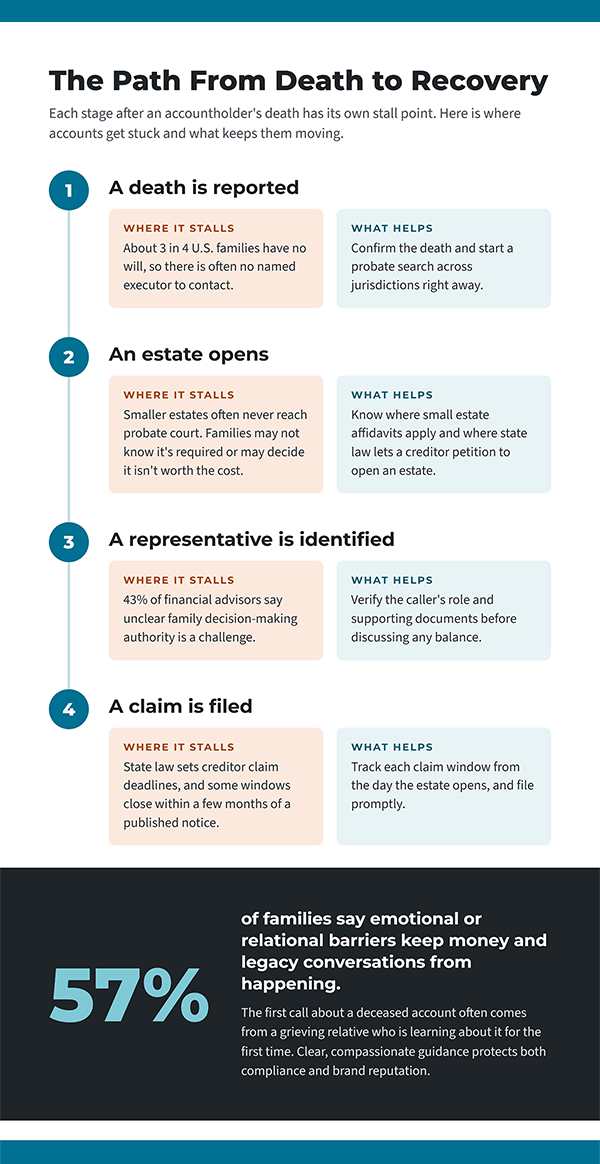
Without a will, there is no named executor. Someone has to petition the probate court to serve as administrator, and for smaller estates that step often never happens. Families may not know it's required, or they may decide the estate isn't worth the time and cost.
That leaves a balance sitting on a deceased account with no open estate, no appointed representative, and no clear next step. Meanwhile, the clock keeps running. Most states set firm deadlines for filing creditor claims once an estate opens, and many also cap how long a claim can be brought after death.
Incomplete paperwork adds a second layer of delay. Missing account records, assets held outside probate, and stale beneficiary designations all change what the estate actually holds. Only 21% of families in the Empathy study reported having updated beneficiary designations, which means many estates will look different on paper than they do in practice.
Who Has Authority to Settle a Deceased Accountholder's Debts?
In most cases, only the estate's personal representative can pay a decedent's debts from estate assets. That person may be an executor named in a will, an administrator appointed by the court, or someone using a small estate affidavit in states that allow one.
Family members generally aren't responsible for a relative's debts. The exceptions include co-signers, joint accountholders, and situations where specific state laws apply, such as community property rules. Regulation F allows collectors to communicate with the person authorized to act for the estate, but the work of identifying that person correctly still falls on the creditor and its partners.
Even professionals who know these families well struggle with this. In the Empathy study, 43% of financial advisors cited unclear family decision-making authority as a challenge, and 51% pointed to incomplete client estate planning. If the people closest to a family's finances have trouble identifying who is in charge, a frontline agent working from a single phone call faces even longer odds.
How Should Recovery Teams Approach Grieving Families?
The people who reach out about a deceased accountholder are usually spouses, adult children, or siblings who are grieving and unsure of their obligations. According to the research, 57% of families say emotional or relational barriers keep them from discussing money and legacy plans at all. Many relatives learn about an account for the first time when they contact the servicer.
That first conversation carries real weight for both compliance and reputation. An agent who suggests, even by accident, that a family member owes a debt they don't creates regulatory exposure. An agent who explains the estate process clearly and respectfully leaves the family with a far better impression of the brand, and many of those relatives are current or future customers.
Decedent accounts call for agents trained specifically in estate work. Scripting should explain liability in plain language and confirm authority before any balance comes up.
What Does a Stronger Decedent Recovery Process Include?
Organizations that recover more from estates tend to share a handful of practices:
Early probate searching. Confirm the death and search for an open estate across jurisdictions as soon as a death is reported, so claim deadlines are tracked from day one.
Authority verification first. Confirm the caller's role and supporting documentation before sharing any account details.
A plan for estates that never open. Know where small estate procedures apply and where state law lets a creditor petition to open an estate.
Specialized staffing. Route decedent accounts to a team trained in estate administration and bereavement communication instead of a general queue.
Separate reporting. Track decedent recoveries on their own so performance and missed claim windows stay visible.
Estate complexity begins before death with powers of attorney and guardianships, and it continues after death as missing wills and scattered paperwork stall the process. A recovery strategy built around a clean, on-time probate filing will miss a growing share of balances tied to this transfer.
Are You Prepared? DCM Services Can Help!
DCM Services focuses on deceased account servicing and estate recovery, with proprietary solutions like Probate Finder OnDemand® and our Signature Service™. If you'd like to learn more about our approach, or if balances are stalling after an accountholder's death, contact us today!
FAQ
-
The debt becomes a claim against the estate. A court appoints an administrator under state intestacy laws, and creditors file claims within the state's deadline. If no estate opens, a creditor may rely on small estate procedures or, where state law allows, petition to open one.
-
Usually not. Debts are paid from estate assets. Family members may be responsible if they co-signed, held a joint account, or live in a state with specific laws such as community property rules.
-
Under Regulation F, collectors may communicate with the executor, administrator, or other person authorized to act on behalf of the deceased consumer's estate.
-
More accounts are tied to estates with no will, outdated documents, and families who don't know the plan. Empathy's 2026 research found only 26% of U.S. families have a will, and 53% expect problems, delays, or conflict during a wealth transfer.