
Every health system has accounts that leave the revenue cycle with a balance and a story nobody had time to read. For example, a patient passes away and the balance moves toward write-off before the estate is properly identified. Or there are times when a bankruptcy petition can reach one department while statements keep flowing from another. Each occurrence looks small, but together, they add up on your bad debt line.
You already invest in registration, eligibility, coding, and denials management. Account status after discharge deserves the same attention. This article shows what better identification can recover, using results from nonprofit health systems, then walks through the process and where to start.
Where Do Deceased and Bankruptcy Status Signals Come From?
Status information reaches your organization through many doors, and rarely in one place. Meanwhile, the account keeps moving through its standard workflow because the record still says active. These are the most common first signals:
Registration or scheduling updates from a relative
Calls from family members to patient financial services
Returned mail and undeliverable statements
Court or trustee notices sent to legal or finance teams
Notes and returns from collection vendors
Public records, such as probate filings and bankruptcy dockets
While each source is valid, the opportunity sits in connecting every signal to the right account at the right time, because every status starts its own clock. Probate courts set creditor claim deadlines, and probate filing windows range from 60 days to one year depending on jurisdiction. Bankruptcy courts set proof of claim deadlines.
Specialty handling starts with seeing each account for what it is. Our articles on the hidden cost of treating every delinquent account the same and why difficult account decisions are also brand decisions explain why.
How Much Revenue Can Better Identification Recover?
Real results answer this best. Two nonprofit health systems using Probate Finder OnDemand® reported these figures for a single year:
| Result | Health system A | Health system B |
|---|---|---|
| Dollars in probate claims filed | $574K | $1.7M |
| Return on investment | 341% and growing | 1,039% and growing |
| Deceased account balances with CMS search efforts satisfied before write-off | $8.7M | $20.1M |
| Probated estate location rate | 25% | 9% |
| Deceased share of active inventory | 4.8% | 2% |
Results vary by portfolio. Location rates ranged from 9% to 25%, and deceased accounts made up 2% to 4.8% of active inventory. Those ranges show why a test on your own data matters.
A larger example shows how fast identification can move. A health system with $2 billion in annual net patient revenue engaged DCM Services to evaluate its estate recovery opportunity. Within five days, Probate Finder identified $37 million in total estates, with 20% of accounts having a probated estate.
What Happens When You Identify a Deceased Patient Account Early?
Early identification moves the account into a process built for estates and gives your team time to act inside court deadlines. Estate accounts follow two main paths:
Probated estates: A court has opened an estate and appointed a personal representative, such as an executor or administrator. Creditors present claims under that court's rules.
Non-probated accounts: No estate has been opened, so the account follows its own path with its own handling.
The right contact is usually the personal representative. A spouse, adult child, or friend may want to help and may carry no legal obligation for the balance. The Federal Trade Commission's policy statement on communications in connection with the collection of decedents' debts describes who a collector may speak with about a decedent's account. It also cautions against implying that survivors owe a debt they do not. State rules vary.
Early identification gives your team:
A confirmed date of death before outreach begins
Visibility into whether an estate has been opened
The identity of the appointed representative
Time to file inside the court's claim window
It also supports respectful communication. Families receive messages that fit their situation, and surviving family members can turn to MyWayForward for support through the estate process.
How Does Bankruptcy Identification Protect Cash and Compliance?
A bankruptcy filing changes what your team can do with an account. Under the Bankruptcy Code, the automatic stay generally pauses collection of pre-petition debts once a petition is filed. Fast identification keeps your outreach aligned with that pause.
Identification also opens the door to recovery. Creditors may file a proof of claim, and Chapter 13 repayment plans route payments through the court's process. Deadlines vary by chapter and case, and charges after the petition date generally follow different rules than earlier balances. A complete bankruptcy process covers six areas:
Nationwide bankruptcy notification and location
Proof of Claim assembly and documentation
Proof of Claim review for accuracy and compliance
Timely court filing
Payment monitoring and remittance management
End-to-end oversight from filing to resolution
What Does a Strong Identification Process Look Like?
A strong process checks status early and routes every account to the right team:
Scrub every account for date of death, bankruptcy, Servicemembers Civil Relief Act status, and updated cell phone numbers before any claim or outreach begins.
Repeat the scrub before write-off to catch late status changes.
Route confirmed accounts to specialty handling.
Match records against probate filings across jurisdictions.
Track every claim window and proof of claim deadline.
Document each step so files stay audit ready.
Report results at the account level.
Signature Service™ applies the first step to every account in a client's estate debt inventory, and more than 300 associates dedicated to estate resolution handle the recovery.
How Do You Strengthen Compliance and Reporting While You Recover More?
Recovery and compliance reinforce each other. Accurate status records, timestamped search logs, and clear audit trails support both. DCM Services frames what CMS evaluates in three pillars:
Compliance: Formalized processes, complete audit trails, and evidence of proactive estate identification
Accountability: Timestamped estate search logs showing when each decedent account was identified, searched, and filed
Sensitivity: Respectful communication with survivors
Related rules include 42 CFR 413.89 for Medicare bad debt, Section 501(r) for tax-exempt hospitals, and the Fair Debt Collection Practices Act and Regulation F for third-party collectors. Probate Finder OnDemand® is backed by ISO 27001, SOC 1 Type 2, and SOC 2 Type 2 certifications and offers CMS-compliant reporting for healthcare-related organizations. Learn more on our Audit and Compliance and Technologies and Security pages.
Where Should You Start?
You can begin with data you already hold:
Pull 24 months of write-offs coded as deceased or bankruptcy, plus accounts with no status check on file.
Run a status scrub to confirm dates of death and filing dates.
Sort confirmed accounts into probated estates, non-probated accounts, and bankruptcy cases.
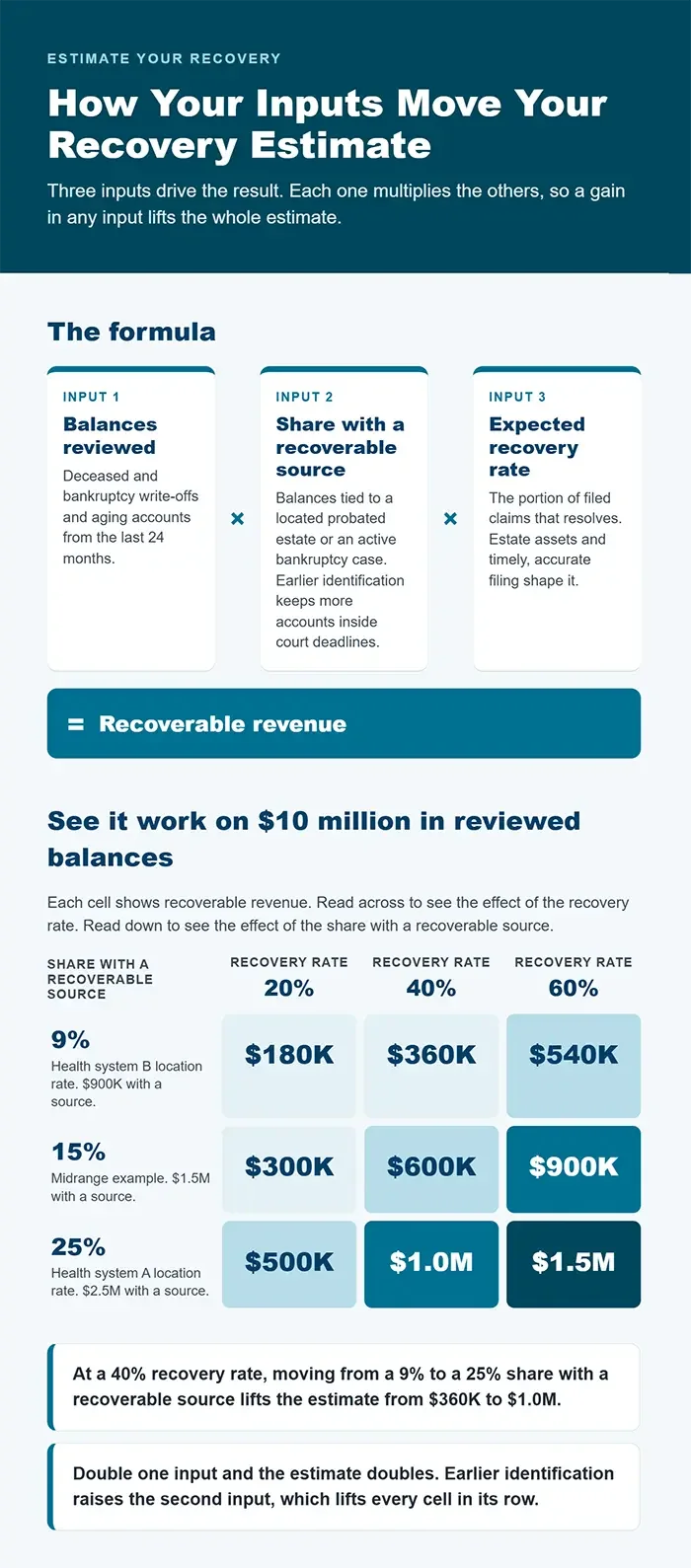
Estimate your recovery range with the formula above.
Compare building an in-house team with the value of a specialist partner. Our article on outsourcing for specialty collections can help.
A Test File Analysis offers the fastest path to real numbers. We create a test file from the last 12 months of your self-pay receivables, closed and active. Then we identify the decedents and estates in your population, match your data to open probated estates, and review the potential return with you.
How Can DCM Services Help Your Team Recover More?
We act as an extension of your team, and brand protection is part of the partnership. Our DCMS for Healthcare page reports that 46 of the top 50 health systems trust DCM Services, with 195K+ claims filed totaling $1.7B and a 0% false positive rate. Three solutions cover the full path:
Signature Service™: Full-service estate recovery that locates probated estates and recovers balances on probated and non-probated accounts. Our largest clients have trusted it with 100% of their estate accounts since 1998.
Probate Finder OnDemand®: Software-as-a-service for probated estate location, matching, and claim presentation, covering 3,400+ courts nationwide and more than 10.2 million estate records.
Bankruptcy Service: Filing identification and verification, Proof of Claim preparation and filing within court deadlines, and payment monitoring through resolution, backed by more than 25 years of specialty recovery experience.
Ready to see what your numbers could look like? Contact us to schedule time with an estate recoveries specialist and ask about a Test File Analysis. You can also watch a demo at probatefinder.dcmservices.com or explore our estate solutions overview and other industries we serve.
Frequently Asked Questions About Deceased Patient and Bankruptcy Account Recovery
-
The share differs by health system. In two nonprofit health systems, deceased accounts made up 2% and 4.8% of active inventory. The most reliable way to learn your number is to review 24 months of write-offs and scrub every account.
-
In many cases, yes. A deceased person's debts are generally paid from the estate, and creditors can present claims to a probated estate within the court's deadline. Rules vary by state.
-
In general, relatives are not automatically personally responsible. Exceptions can apply, such as a co-signer or joint account holder, and state laws differ. Communications should never imply personal responsibility where none exists.
-
The automatic stay generally pauses collection of pre-petition debts. Creditors may file a proof of claim, and the bankruptcy chapter and court deadlines shape what happens next. Identifying the filing early helps your team respond within those timelines.
-
Before any claim, outreach, or write-off. At DCM Services, every account is scrubbed for date of death, Servicemembers Civil Relief Act status, bankruptcy, and updated cell phone numbers before any claim or outreach begins.
-
It is a software-as-a-service platform that automates probated estate location, matching, and claim presentation across 3,400+ courts and more than 10.2 million estate records. The platform matches estate records, prepares claims, and files them under expert management, backed by a specialized probate support team.
-
It is a test file built from the last 12 months of your self-pay receivables, closed and active. The analysis identifies decedents and estates in your population, matches your data to open probated estates, and reviews the potential return on investment. Contact us to request one.