

For years, outsourcing in financial services followed a simple strategy: move work to a lower-cost provider and save on staff. That equation still works for some functions, but for the most complex accounts in a portfolio, leaders now ask a different question: Which capabilities can we build well on our own, and which should we access through a partner?
Outsourcing for specialty collections sits at the center of that question. Deceased accounts, bankruptcy filings, and court-supervised cases make up a small share of most portfolios. They carry outsized regulatory, reputational, and financial weight. They also demand expertise, data, and technology that internal teams rarely get the chance to develop.
How Has Financial Services Outsourcing Evolved?
Outsourcing in financial services has moved through three broad stages. Most institutions still use a mix of all three.
Stage one: labor savings
Early outsourcing models focused on cost. Institutions moved call centers, data entry, and back-office tasks to providers with lower labor costs. Success meant a lower cost per account.
Stage two: capacity and performance
Collections teams added contingency placements and champion/challenger programs. Agencies competed on recovery rates. The institution placed accounts, measured results, and shifted volume to the top performer.
Stage three: capability access
Today, the strongest outsourcing relationships give institutions something they would struggle to build. That includes specialized expertise, proprietary technology, unique data, and compliance infrastructure designed for one type of account.
Each stage solved a real problem. The third stage matters most for specialty collections, because the work depends on depth that takes years to develop.
Why Do Specialty Collections Strain Internal Operations?
Most collections operations run on processes built for the common case. The account holder is known. The contact information is current. The next steps follow a predictable path. Policies, training, and technology all support that path.
Specialty accounts follow different rules, as outlined in our previous article, “The Hidden Cost of Treating Every Delinquent Account the Same: Why Specialty Collections Matter.” A deceased account requires estate research, probate filings, and conversations with grieving families. A bankruptcy account requires court filings, proof of claim deadlines, and strict adherence to the U.S. Bankruptcy Code. A court-supervised case requires coordination with a guardian, conservator, or other appointed party. Each one carries its own legal requirements, timelines, and documentation standards.
This creates what we call the economics of exceptions. It shows up in four ways.
Low volume limits expertise
When a team handles a few specialty accounts each month, staff rarely build deep pattern recognition. Procedures used once a quarter fade between cases. Training on them fades even faster.Knowledge concentrates in a few people
Situations arise where a lone seasoned veteran often knows how to handle an unusual estate or a complex bankruptcy chapter. When that person retires or moves on, the knowledge leaves with them.Internal technology creates unseen gaps
Internal IT teams prioritize systems that touch the most accounts. A tool that searches thousands of probate courts or tracks bankruptcy deadlines rarely wins that competition. Teams fill the gap with spreadsheets and manual research.Compliance depends on memory
When specialty work runs on manual steps and individual knowledge, documentation thins out. Examiners and auditors often focus on exactly these files.
These pressures appear even in well-run operations. They also come from the math of low volume and high complexity.
Where Do Specialized Partners Create Advantage?
A specialized partner reverses the economics of exceptions. The accounts your team sees a few times a month make up a partner’s core workload. They handle that work every day, across many clients, and invest to match.
That focus creates advantages in five areas.
Combined volume builds expertise
A partner that works thousands of estate and bankruptcy cases sees patterns a single institution rarely encounters. Staff learn how different jurisdictions, chapters, and family situations play out.Technology and data spread across clients
A partner can justify expensive tools that no single institution would fund alone. Examples include nationwide court monitoring and automated estate matching, such as our Probate Finder OnDemand® platform, and deceased and bankruptcy scrubs at scale.Trained staff handle sensitive conversations
Specialty accounts often involve people going through a tough time. A surviving spouse or adult child may not know their rights or obligations and need a gentle, compassionate voice that effectively communicates these points. Representatives trained for these conversations protect the consumer and the institution’s brand.Compliance lives inside the workflow
Specialists design each process around the rules that govern the account type. Deadlines, verification steps, and documentation become standard steps in every case.Reporting tracks outcomes
A focused partner can show what happened to each account: when it was identified, which stage it reached, and how it resolved. That visibility supports performance management and exam readiness.
Which Functions Belong in Outsourcing for Specialty Collections?
Strong outsourcing decisions start with a clear view of what operations should stay internal. Core, high-volume work builds your institution’s skill and defines your customer relationships. Four tests help separate that core work from work that belongs with a specialist:
Frequency
How often does your team handle this type of account? High-frequency work builds internal skill on its own. Low-frequency work rarely does.Complexity
How much does each case vary? Simple, repeatable tasks suit automation or a standard vendor. Work that changes by jurisdiction, bankruptcy chapter, or family situation calls for deep expertise.Consequence
What happens when something goes wrong? Weigh regulatory exposure, reputational risk, and lost recoveries. A missed claim deadline can erase a recovery entirely. Some organizations face added stakes. Healthcare providers, for example, may need to document reasonable collection efforts on deceased patients’ accounts to support reimbursement claims.Cost to build
What would it take to do this well internally? Count technology, data, training, and the time to reach full competence. Then compare that investment to the volume it would serve.
Plot each function on two dimensions: how often it occurs, and how complex and consequential it is. The matrix below shows where each combination usually belongs.
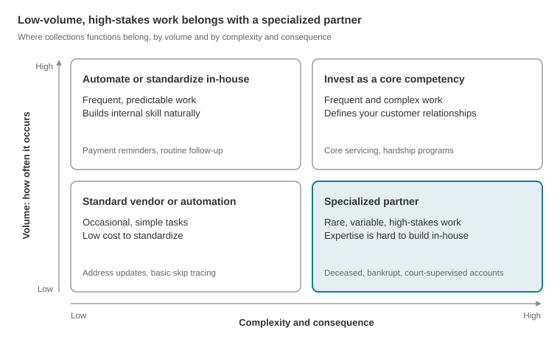
Most specialty collections land in the lower-right quadrant, with low volumes, wide variations, and a high risk for serious consequences when handled poorly or non-compliantly. That combination makes these accounts strong candidates for a specialized partner.
Does Outsourcing Transfer Compliance Risk?
Outsourcing moves the work, but accountability stays with the institution. Federal banking regulators made this clear in their 2023 Interagency Guidance on Third-Party Relationships. Institutions must manage third-party risk across the full lifecycle: planning, due diligence, contract terms, ongoing monitoring, and termination.
This raises the bar for partner selection. The right partner makes your oversight easier. Look for:
Audit-ready documentation on every account
Independent certifications such as SOC 2 Type 2 and ISO 27001
Clear complaint handling and escalation paths
Reporting that shows outcomes and exceptions at the account level
Proactive updates as laws and regulations change
The number of vendors matters too. Many institutions spread specialty accounts across several agencies. Each relationship requires its own due diligence, monitoring, and audits. Splitting low volumes across many vendors also keeps any single partner from building depth on your accounts.
Consolidating with fewer, more specialized partners reduces the oversight burden. It also gives each partner the volume to learn your portfolio inside and out.
What Role Do AI and Automation Play in Specialty Collections?
AI now appears on nearly every financial services roadmap. However, specialty collections present a particular challenge for these plans. AI performs best with large volumes of clean, relevant data. Inside any one institution, specialty accounts produce small data sets. A model trained on a few hundred deceased or bankrupt accounts a year has little to learn from. It also has few examples of the edge cases that matter most.
Specialized partners hold an advantage here. They work with far larger data sets for each account type. They know which steps follow clear rules and which require judgment. That knowledge lets them apply automation where it adds the most value:
Matching accounts to estate records and court filings
Flagging new bankruptcy filings and deceased indicators
Tracking claim deadlines across jurisdictions
Routing each account to the right workflow from day one
The best results pair automation with well-trained people. Technology handles identification, matching, and tracking at scale. People handle conversations with families, claim review, and decisions that require context. This balance improves speed and accuracy while keeping every consumer interaction human.
When you evaluate partners, ask how they use AI and automation. What data trains their models? How do they test for accuracy? Where do humans remain involved? Additionally, evaluate their understanding of these models. Did the agency build proprietary processes with efficacy and compliance in mind, or did they simply piecemeal together a working model from several technology vendors without fully understanding how they operate? From a cost perspective, remember there is overhead associated with purchasing these models that gets passed to their clients. Finally, from the regulatory aspect of interagency guidance, always consider the fact a partner’s technology becomes part of your risk profile. These issues deserve the same scrutiny as any other part of your due diligence during the partner selection process.
What Should Leaders Look for in a Specialty Collections Partner?
A partner’s focus, history, and reporting reveal more than any sales presentation. Use these questions to guide your evaluation:
Focus
How much of the partner’s business centers on specialty accounts? Depth comes from repetition.Experience
How long has the partner worked these account types? How tenured are its managers and agents?Proprietary technology and data
What can the partner do that your team would struggle to replicate?Compliance and security
Which certifications do they hold? How do they document each step of each account?Consumer experience
How do they train staff for sensitive conversations? What support does it offer surviving family members?Reporting
Does the partner report on outcomes and exceptions at the account level?Partnership model
Will they consult on strategy, process design, and regulatory change?
How Should Your Operating Model Change?
Outsourcing for specialty collections works best as part of a deliberate operating model. The first step is drawing a clear line between strategy and execution. Your team keeps ownership of risk appetite, policy, performance targets, and third-party oversight. The partner owns the day-to-day work: identification, research, filings, communication, and resolution, all within standards you agree on together.
Shared measures keep both sides focused on results. Outcome-based KPIs work best, such as track recovery rates, time to resolution, claim filing timeliness, complaint rates, and how well exceptions get handled. These measures show whether accounts actually reach resolution.
Data and communication work to hold the model together. Secure, regular data exchange gets accounts to the partner quickly and brings results back cleanly. Expediency matters, because many specialty processes run on fixed deadlines. Regular meetings give both teams a chance to review results, discuss regulatory changes, and adjust processes together. The strongest relationships work like an extension of your team.
This structure lets each side do what it does best. Your team keeps control of strategy and risk. Your partner brings the depth that specialty accounts demand.
The Question Every Leadership Team Should Ask
Start with one question: If we built our operations from scratch today, which functions would we choose to build ourselves?
For specialty accounts, most institutions reach the same answers.
“The expertise takes years to develop.”
“The technology serves too few accounts to justify internally.”
“The stakes keep rising as the population ages and more accounts move into estates.”
All of these point to allowing a strategic partner to create a mutually beneficial relationship. Your team can focus on the work that defines your institution, and the partner handles the accounts that demand its depth. The result for you is stronger recoveries, cleaner compliance, and a better experience for the families and consumers behind every account.
Want to see how specialty accounts fit into your operating model? Contact us to review your current approach and talk through where a specialized partner can help!
Frequently Asked Questions about Specialty Collections Partners
-
Outsourcing for specialty collections means partnering with a specialized provider to manage complex accounts. These include deceased, bankrupt, and court-supervised accounts. Each follows different legal rules and timelines than standard collections, so each benefits from dedicated expertise, technology, and compliance processes.
-
Common examples include accounts of deceased customers, accounts in bankruptcy, and accounts managed under court supervision by a guardian, conservator, or estate representative. Each type carries its own legal requirements, deadlines, and communication rules.
-
No. Institutions remain responsible for activities that third parties perform on their behalf. Federal banking regulators expect institutions to manage third-party risk through due diligence, contract terms, ongoing monitoring, and clear exit plans.
-
Apply four tests: frequency, complexity, consequence, and cost to build. Low-volume, highly variable work with serious regulatory or reputational consequences usually belongs with a specialized partner. High-volume core work usually stays in-house.
-
Specialized partners use automation to match accounts to estate records, identify new bankruptcy filings, and track claim deadlines. Trained staff handle consumer conversations, claim review, and decisions that require judgment.
-
Look for depth of focus, years of experience, proprietary technology and data, independent compliance certifications, consumer experience training, account-level outcome reporting, and a consultative partnership model.